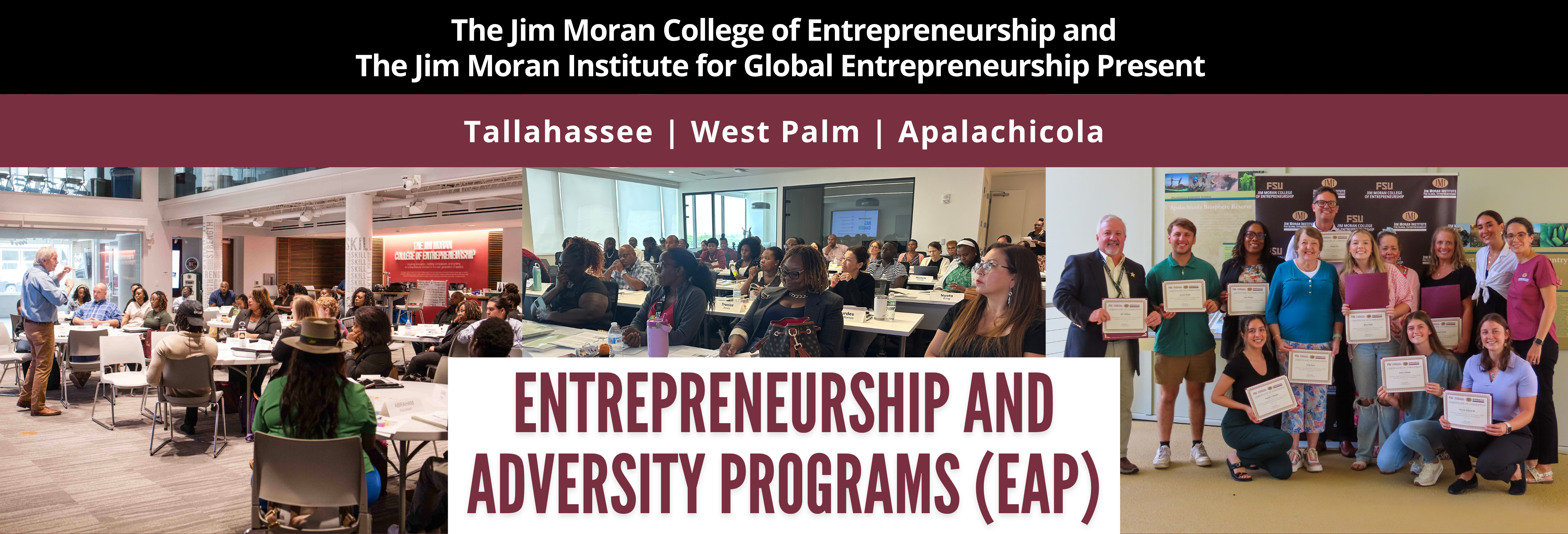
Our Locations:
About
The Jim Moran Institute’s Entrepreneurship and Adversity Programs (EAP) expand access to entrepreneurship education and support for low- and moderate-income individuals across Florida. Through initiatives in Leon County, West Palm Beach, and Apalachicola, EAP provides participants with practical business education, mentoring, resources, and connections designed to help them develop sustainable ventures and strengthen their financial independence. While each program is tailored to the needs of its local community, all share a common commitment to using entrepreneurship as a pathway to economic mobility and opportunity.
Entrepreneurship and Adversity Program Mission Statement
To expand pathways to economic mobility by empowering low- and moderate-income individuals with the entrepreneurial skills, mindsets, resources, and support needed to build sustainable ventures and achieve greater financial independence.
Proud Partners of the Urban Poverty and Business Initiative (UPBI)
The Urban Poverty and Business Initiative (UPBI) is specifically tailored to address the challenges faced by low-income and disadvantaged individuals as they navigate the various stages of the entrepreneurial process. It involves a multi-tiered intervention process for preparing entrepreneurs to create sustainable businesses. Based on a proprietary, research- and experience-based approach that centers on leveraging university and community resources to support these entrepreneurs, the annual program involves a staged intervention approach unfolding over ten months, and includes training, mentoring, student consulting, community connection events, access to microcredit, and research/tracking. It employs a unique toolkit that reflects the distinct needs of poverty entrepreneurs and tracks participants as they navigate eighty activity steps in moving to a sustainable enterprise.

Our most vital lesson learned to date is that ‘progress begets progress’. Entrepreneurship is a journey of many steps, and to a person in disadvantaged circumstances, the process can seem overwhelming. For this reason, we identified 80 activity steps in the journey from an idea to a sustainable enterprise, and we walk the low-income individual through these steps. We employ a unique model based on the SPODER framework outlined in our book Poverty and Entrepreneurship in Developed Economies (Morris, Santos & Neumeyer, 2018, Edward Elgar Publishing) and on our 25 years of experience working with disadvantaged entrepreneurs. The interconnected components include:
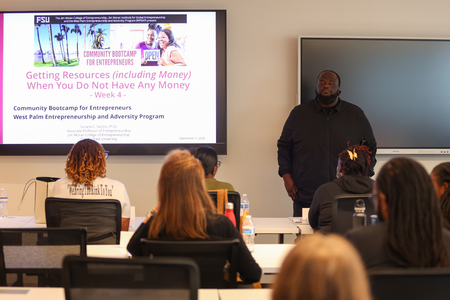
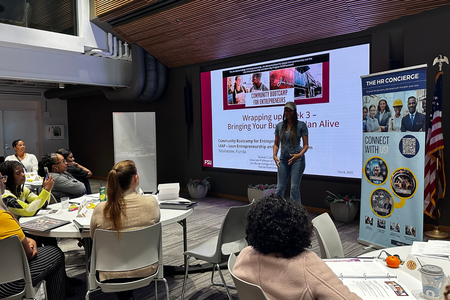
Training: This includes a) a six-week bootcamp that introduces tailored tools, concepts, and principles relevant to launching and growing a successful venture when one has little to no resources or background and comes from adverse circumstances, and b) monthly training forums on specialty topics. Training is delivered by seasoned faculty, subject matter experts, and successful entrepreneurs and addresses the development of the individual and the venture.
Mentoring: Participants who complete the training then receive a mentor who is a successful entrepreneur and, to the extent possible, has experiences directly related to the participant’s business. In addition, an ‘expertise pool’ of mentors is available with advice on specific problem areas. Mentors provide guidance, advice and serve as a sounding board to the entrepreneurs we are serving. Most are from the local community, but we also tap the university alumni base.
One-on-One Consulting: Following the mentoring, a consulting initiative finds faculty and students working with individual entrepreneurs on particular problems and needs. Student consultants produce tangible deliverables for the entrepreneurs over 14 weeks. In addition to formalizing the client’s business model, they register businesses, develop websites, set up bookkeeping systems, develop marketing materials, create social media campaigns, design prospecting systems, assist with pricing, help with procurement, and provide an array of solutions in other areas of the business.
Community Connect: Involves a series of initiatives that connect entrepreneurs with other community resources through community forums, an online platform for marketing these ventures, and other networking vehicles. A central aspect of this is quarterly Community Connection events, where we engage the business community to support these disadvantaged entrepreneurs and feature the program participants and their ventures at social networking events.
Microcredit: Involves working with the local organizations and financial institutions to create a pathway to microcredit, or affordable-interest business loans, for individuals who otherwise struggle to qualify for bank or other forms of financing. We employ a three-stage process when working with program participants to help prepare them for loans from existing microcredit funds and conventional lenders.
Research and Tracking: Ongoing research documents the challenges these entrepreneurs face and tracks their progress, while identifying elements that successfully help them move forward. Thirty-seven key variables are tracked for each program participant over three years, including their progress through 80 activity steps.